As 2025 comes to a close and we wrap up the commemoration of our 35th anniversary, we look ahead to 2026. The FPA extends our deepest gratitude to every member of the facial pain community. For more than three decades, your courage, compassion, and persistence have shaped who we are and guided the work we do. Your willingness to support one another, to share knowledge, and to advocate for better care and greater understanding has allowed the FPA to pursue our mission with purpose and renewed commitment.
Each year, we learn more about facial pain, about the realities of living with it, and about the remarkable strength found within this community. Your stories, your questions, and your determination help drive research forward, inspire new educational efforts, and ensure that no one has to navigate this journey alone.
As we move into the next chapter, we encourage you to continue sharing your experiences and your voices. Every story widens the circle of understanding. Every connection offers comfort. And every act of advocacy helps illuminate a path forward. Together, we will continue to build hope, expand awareness, and strengthen the bonds that carry us all.
This moment of transition is also an opportunity to acknowledge the leaders who have helped bring the FPA to where it is today. In 2025, Jeff Bodington stepped down from the FPA Board of Directors. We celebrate his remarkable contributions and lasting impact over the past 15 years — especially during his tenure as Board Chair from 2012 to 2018. Under his steady leadership, the FPA made tremendous strides. His deep passion for the FPA was evident throughout our conversation, matched only by his hopes for its future.
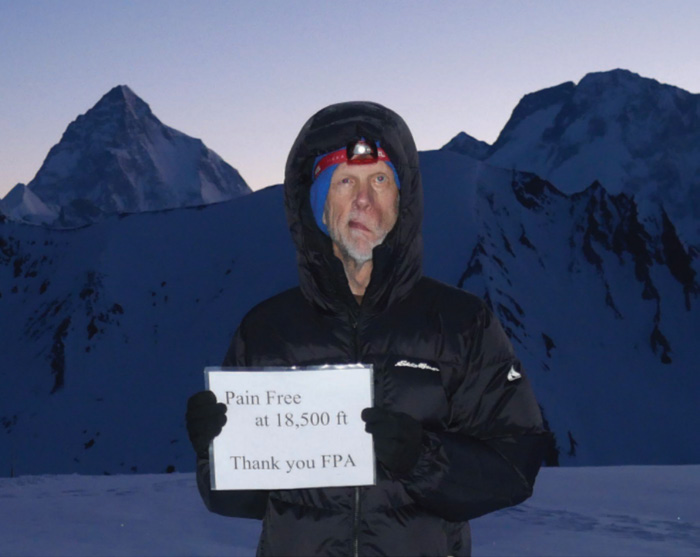
A distinguished executive with deep expertise in the financial side of the electric power industry, Jeff brings drive and determination to every aspect of his life— including his recent summit of Mount Kilimanjaro. Beyond these achievements, Jeff’s personal journey with trigeminal neuralgia (TN) speaks volumes about his resilience. Having lived with the condition for years, he chose a surgical path a decade ago that has left him pain-free ever since.
Jeff’s unwavering commitment to the FPA can be captured in one simple yet powerful phrase: for the patients. We offer our heartfelt thanks and admiration for his visionary leadership, tireless dedication, and the inspiration he’s provided to all who have had the privilege of working with him. Please read on for an interview with Jeff by Danielle Clements, our 35th Anniversary Correspondent.
You’ve been an integral part of the Facial Pain Association for almost 15 years, overseeing so many different initiatives and the implementation of many changes. Going backwards a bit, what led you to the FPA in the first place?
While I was dealing with the medications for my trigeminal neuralgia, I found out about a local support group. I went and found it quite useful. That was my introduction to organizations that provide help to people trying to manage their lives outside of the doctor’s office. I thought, well, this is an organization which is really helping people, so I started supporting it. At one point, I received a call from the CEO who said, “Hey, would you consider joining our board? We’d like to talk to you about doing that.” So, I joined the board.
Within two years, I was chairman of the board, and I was chair for seven years. I continued to be an active member under the new chair, David Meyers, who is very capable. I just recently stepped down from the board and now I’m an emeritus director.
The FPA marked its 35th year as an organization in 2025. You’ve seen a lot of progress in your time. What would you like to see for the future of the FPA?
I’d like to see a couple of things. We are already the go-to organization with more resources and more services [for patients with facial pain and discomfort] than any other organization on earth. While we’re translated into a couple of other languages, the people that we really help are primarily in North America. Well, there are actually six other continents that we could be useful to. I’d like to see that.
I started what we call the Inclusive Initiative. The idea is that if you look at who is evident that we help, it is primarily well-educated and prosperous people for the most part. And why is that? Well, we provide a huge amount of information to people on the internet, and we’re working to make it more available across people with facial pain.
Facial pain doesn’t care what your education is or how much money you make or your religion or anything else. We’re working to find a way to be more available to everyone with facial pain, and that’s very difficult.
We provide everything free, the internet makes it free and available, but not everyone’s facile with the internet. How do we reach those people? We need to figure that out. I would also like to see us, and we’re working on this too, play a bigger role in research to help find better treatments.
And that needs to be done carefully. It needs to be done in a way that takes advantage of what we can do well, which is deliver patients like no one else can on earth to researchers for studies. But be careful about things that we can’t do well, like deciding who should get what research funding. We don’t have that expertise. So, I would love to see us more involved in effective research, but in a way that uses our strengths and does not creep into things which we can’t do well.
Such a significant portion of the FPA revolves around volunteerism. There are so many support groups and various volunteer opportunities and positions. Why do you think support is so important for patients suffering with this kind of discomfort and pain?
I’m going to start back a few steps. When, I’ll say “I,” but a lot of people get credit, but when I was pushing for elevating the role of the Young Patients Committee (YPC) and the importance of support groups, there were those at the FPA at the top on the staff and among the board who said, you know what, in-person stuff doesn’t matter. The future is the internet. And I thought, that is wrong.
Especially amongst young people, it was so dramatic at one of our national conferences. We’d set aside a special room just for the YPC people to get together. What happened in that room utterly destroyed the idea that this could be all done over the internet. These young people, who were so facile with the internet, got together in person with others who struggled with this disease, and they were in tears.
It was so moving, so important, so human. And that’s the importance of the support groups as well. The internet cannot replace face-to-face, person-to-person interaction.
Being there in the same room is not the same as downloading a brochure. And I think that the interaction and the human connections made through support groups and getting people together at in-person conferences, as I’ve said, brings people to tears. You know, this disease will wreck your life.
Helping people find out they can manage it is a wonderful thing that the FPA does. And part of that is you’re finding out you’re not alone, and you can communicate with others about this disease and how it affects your life on more levels than downloading a brochure or a Zoom class.
This has really been great, thank you so much for your time and of course your efforts over the years.